

User & stakeholder research
Information architecture
Prototyping & usability testing
Cross-functional collaboration
Fleet owners in Pakistan's trucking industry were running their entire businesses through WhatsApp — finding jobs through broker connections, coordinating drivers over calls, and tracking deliveries manually. I was brought in as the sole designer to take this from zero to a shipped Android app. The challenge wasn't just digitizing their workflow — it was designing for users who had never used a purpose-built business tool before.


Access to work was controlled by a handful of brokers. Fleet owners weren't struggling to find trucks or drivers — they were stuck waiting on a small network of brokers who controlled job allocation. Securing a single shipment took an average of 3 days, and owners had no way to go direct. Every day without a job was money lost.
💡 Opportunity: Connect fleet owners directly to shippers, removing the broker dependency entirely.
Manual operations were creating costly, invisible risks. Driver availability, vehicle conditions, booking history, and finances were all tracked through WhatsApp messages and personal notebooks. There was no single source of truth. Owners were regularly making decisions — like bidding on jobs — without knowing if they had the drivers to fulfill them.
💡 Opportunity: Centralize fleet operations into one reliable platform so owners can make confident decisions without chasing information across messages and notebooks.

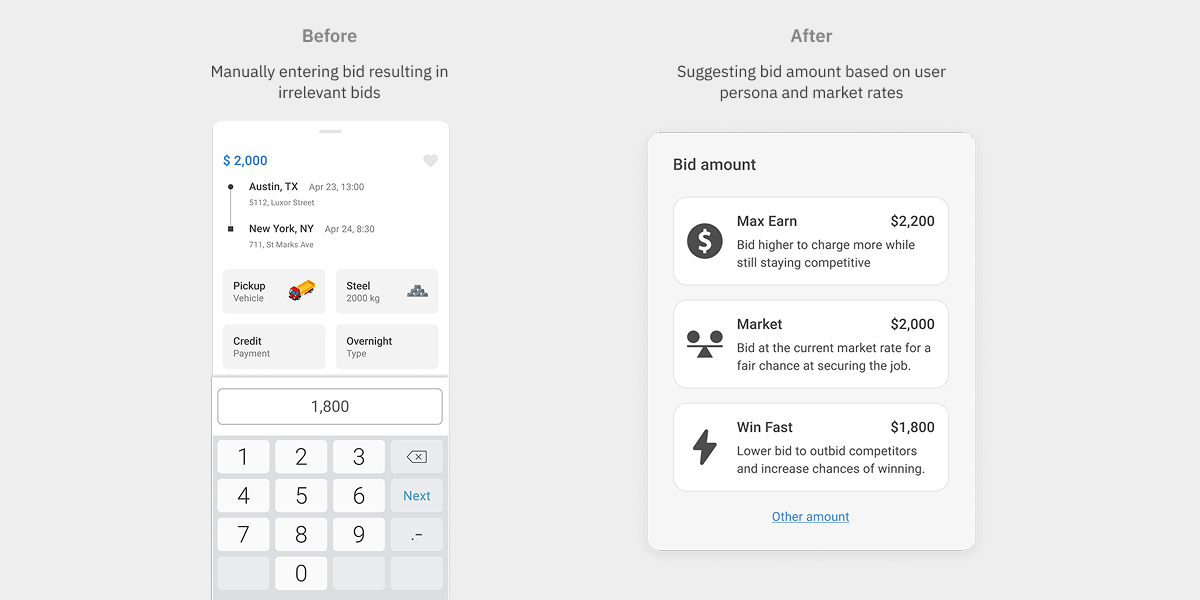
Reducing noise to build shipper trust. Early testing gave fleet owners complete freedom to bid any amount. This created a flood of erratic, lowball bids that frustrated shippers and made the platform feel unreliable. I proposed structured bidding strategies based on observed user behavior — owners could choose to maximize earnings or stay competitive. Bid quality improved immediately, and platform engagement increased by 50%.

Fixing a workflow that set owners up to fail. The initial flow matched the owner's mental model: win the bid, then assign a driver. In testing, this consistently backfired — owners would secure jobs only to find no drivers were available, damaging their reputation with shippers. I redesigned the flow to require driver confirmation before a bid could be submitted. It was a small friction that prevented a much bigger failure.
Designing for how users actually work, not how we assumed they would. Early assumptions pointed toward a web app as the default starting point. But through field research, a clear pattern emerged — fleet owners and drivers operate almost entirely on mobile, often in trucks, depots, and on the road with no access to a desktop. WhatsApp itself was the proof: their entire business already lived on a phone. Building for Android first wasn't a technical preference — it was the only choice that met users where they actually were.
I designed a dual-sided Android app: a job board marketplace for discovering and bidding on freight jobs, and a fleet management layer for tracking drivers, vehicles, and bookings — all replacing the fragmented WhatsApp workflow with a single source of truth.

Fleet owners needed to feel in control for the first time. I prioritized search and filtering prominently so users could scan relevant jobs in seconds, rather than waiting passively for a broker's call. The result: job discovery time dropped from days to under an hour.
Early testing revealed a critical flaw: open bidding led to erratic, irrelevant bids that frustrated shippers and undermined trust in the platform. I introduced structured bidding strategies — "maximize earnings" vs. "stay competitive" — based on observed user behavior. This reduced bad bids and increased engagement by 50%.


Keeping managers in control after the bid is won. Once a job is secured, the work doesn't stop. Managers can monitor live shipment deliveries and driver locations directly through the app — no more chasing drivers over phone calls to get a status update. Real-time visibility means faster decisions, fewer delays, and fewer costly surprises.

